
Crawler and sat bashers always get their comeuppance, it seems  congratulations on the top 1 hit!



Crawler and sat bashers always get their comeuppance, it seems congratulations on the top 1 hit!
Moved to top 10, well done!
Congratulations on a superb hit, moved to top 10!
Congratulations on the current top 1!
Persistency is well rewarded! Moved to top 10
Colonisation Guide
For a starfaring empire to truly prosper, it needs well developed planets brimming with production and activity. To achieve that, one needs to establish colonies, but the choice for each must be selected carefully.
Colony Ship
Before any sort of expansion can be done, a Colony Ship must be built. This is the first objective for any new emperor to rapidly expand and secure the best positions in the galaxy.
Other ships can be sent with the colonisation mission to deliver additional resources, but they will return to the origin planet afterwards.
Location, Location, Location
In OGame, each system has 15 slots to colonise, in which slot 1 is the closest to the sun and slot 15 is the farthest from the sun. Aside from temperature (which affects Solar Satellite output and deuterium production), some slots offer additional benefits.
The above benefits make all other resource production enhancers such as Lifeforms, booster items or Geologist officer more effective, making these slots valued for miners. Generally, slots 6-10 and 15 tend to be settled in active galaxies while the others are rarely occupied, unless filling slots for an alliance system. Note: slots 1-3 and 13-15 require additional Astrophysics research before they can be settled.
Planet Size Matters
Aside from production benefits, slots vary in how large the colonised planet can be. The largest planets can be found in slots 6-10, while the smallest ones are in slots 1-3 and 13-15. The amount of fields a planet can support is determined by the formula: (Planet Diameter ÷ 1000)^2. As an example, a planet with the diameter of 15 000 km has 225 fields.
The player class Discoverer and alliance class Researchers add 10% and 5% to the planet diameter on colonisation, respectively. With both of these, the example planet from above has 297 fields, making them valuable for establishing long term colonies. In most cases, it is advised to keep planets with more than 250 fields. A visual table is available below showcasing possible planet sizes and benefits. Note: if the universe has a setting that adds bonus fields to a planet, that number is added on top, unaffected by other bonuses.
Relocations
Whether one wishes to improve their production or get closer towards their targets, it is possible to move any of your colonies to any other position, for a one time payment of 240 000 DM (120 000 DM during an event). There are some caveats to this:
Note: it is possible that after executing a merge to a different server, your planets will lose their original positions. While temperatures will be preserved, any slot based production benefits will be lost. A free relocation is granted to the account for each lost position.
Welcome, Commander!
Whether you're a returning player or a new one, there is one important decision you have to make before beginning: choosing your universe.
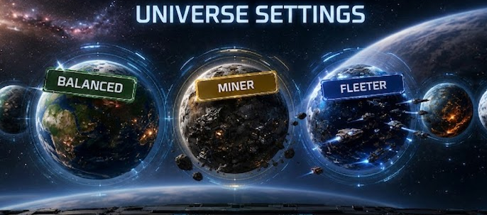
Each one has a plethora of different settings which may seem overwhelming at first, but they are crucial for your playstyle! A miner will naturally prefer where they can develop in peace, while a fleeter will enjoy more where they need to wait the least for their next blaze of glory.
Universes are divided in the following categories:
⚖️ Balanced - has settings which support both peaceful and aggressive play.
⚒️ Miner - has settings that lean towards peaceful play. Usually this means low war fleet speed, no DiDF, and high galaxy amount.
⚔️ Fleeter - has settings that lean towards aggressive play. Usually this means high war fleet speed, enabled probe storage and reduced ship deuterium consumption.
Please note that these categories do not exclude any playstyle, but rather shape what sort of experience you can expect. Additionally, younger universes tend to be more lively and have plenty of active alliances, but older universes have more inactive accounts which can be raided to bolster your own growth.
The following list details every universe setting currently offered by OGame:
Economy Speed
Determines mine production, how quickly buildings upgrade, and the rate at which ships are built. Additionally determines the size of ship and resource rewards gained from expeditions.
Economy speed can go from x1 to x10. Higher numbers make for faster development, while lower numbers are closer to the original OGame experience.
Research Speed
Determines how quickly researches and lifeform researches are completed.
Research speed can go from x1 to x20. It is the multiplied value of economy speed, typically doubled, but it is possible to have other values.
Peaceful Fleet Speed
Determines the speed of transports, deployments, colonisation and expeditions (only the speed towards and from slot 16 is affected).
Peaceful fleet speed can go from x1 to x8. Note that a high amount means your fleetsave will be much shorter, so be sure not to miss it!
Holding Fleet Speed
Determines the speed of ACS Defend missions. If the universe has ACS disabled, this value has no effect.
Holding fleet speed can go from x1 to x8.
War Fleet Speed
Determines the speed of attacks, ACS attacks, harvesting, espionage and missile attacks.
War Fleet Speed can go from x1 to x5. Higher value additionally decreases the Jump Gate cooldown.
Galaxies
Determines how many galaxies the universe has.
Galaxy amount ranges from 4 to 9. Fleeters tend to prefer lower values as it makes attacks easier.
Donut Galaxies/Systems
Determines whether the distance from galaxy 1 to galaxy 9 is the same as the distance from galaxy 1 to galaxy 2.
Determines whether the distance from system 1 to system 499 is the same as the distance from system 1 to system 499.
They can be linear or circular. Linear galaxies and systems drastically increase fleet travel time.
Empty/Inactive Systems
Determines whether fleet travel time between systems ignores those which are empty, or populated only by inactive players.
They can be on or off. Universes with these enabled have their fleets execute missions quicker, which can be both a positive and a negative.
Bonus Fields
Determines how many additional fields each planet gets after combining their base amount and bonuses, if any.
Bonus field amounts range from 0 to 30. Higher amount reduces reliance on Terraformers and premium planet field items.
ACS (Alliance Combat System)
Determines whether the universe supports ACS.
It can be on or off. Note that if ACS is disabled, attacks can't be slowed down with safety probes.
DF % (Debris field percentage)
Determines how many resources from destroyed ships go into the debris field.
Debris field percentage can go from 30% to 80%. As an example, that means a single Espionage Probe can grant from 300 crystal, up to 800 crystal.
Higher values decrease the amount of ships needed for ideal moonshots.
DIDF % (Defence in debris field percentage)
Determines how many resources from destroyed defences (that weren't rebuilt) go into the debris field.
Defence in debris field percentage can go from 0% to 80%. As an example, that means a single Rocket Launcher can grant from 0 metal, up to 1600 metal.
Any value above 0% makes building defences very risky as they can be profited from! However, destroyed defences count for moonshots.
Deuterium to DF
Determines whether deuterium from destroyed ships and defences (if applicable by the above setting) goes into the debris field.
It can be on or off. Note that deuterium does not count for the resources needed to create a moon.
Deuterium Consumption
Determines how much deuterium ships require to be sent on missions.
Deuterium consumption ranges from 0.5 (halved) to 1.0 (full). Lifeforms research cannot decrease this amount below 10% of base value.
Probe Storage
Determines whether Espionage Probes have their cargo capacity enabled.
It can be on or off. The base storage value of a probe is 5. This can allow for very rapid raids or transports, albeit heavy in deuterium cost due to the large amounts needed.
Starting DM (Dark Matter)
Determines how many free Dark Matter is granted upon account creation. Note that this DM does not prevent account deletion due to inactivity!
Starting DM ranges from 0 to 25 000. Dark Matter can be used to speed up account development, especially in the starting days of an universe.
Expeditions & You: The Advanced Guide
The most daring admirals know that great wealth lies over the event horizon: expeditions allow a diligent player to lead their empire to unprecedented progress and prosperity. But before the ambitious emperor can take advantage of expeditions, there is useful knowledge to be had, to ensure your fleets return safe and loaded to the brim with material!
Most From Least - Rewards & Fleet Composition
The amount of resources and ships you can find on an expedition is determined by several factors: fleet expedition points, universe economy speed, inclusion of Pathfinders, player class and the top player's points.
Note that the other positive rewards (Dark Matter, items, traders) are unaffected by the list below.
So what kind of fleet should you send on expeditions?
One that maximises expedition points while minimising losses from pirates, aliens and black holes — one combat ship (the strongest you have), one Pathfinder (to maximise rewards), one Espionage Probe (to track slot depletion, explained later) and a varied amount of Small or Large Cargoes (to carry all that loot back).
As the multitude of factors can dramatically vary the amount of cargo ships needed, it is best to use a calculator like Expocalc or Proxyforgame to quickly determine the right number. Some approved addons provide the same function.
Hold Time - Does It Matter?
Increasing the hold time simply increases the chance an event will happen. It does not increase the possible reward, but in the case of a delay event, it increases the time until your fleet returns by the following formula: Holding Time ÷ Universe Peaceful Fleet Speed. It may be tempting to use a long hold time overnight to keep expeditions going, but one should rather decrease the fleet speed instead, as it will lessen the impact of a delay event.
Depletion - Why To Avoid it
Each slot 16 in a system has a depletion stat, which impacts the chance of an event happening. This is why one should send an Espionage Probe with their fleet, to determine if the slot still has low depletion (some addons provide the same function). As depletion is shared with all players in an universe, it is best to vary the locations one sends their expeditions towards, as high depletion can drastically reduce the amount of rewards.
Pirates & Aliens - Hives Of Scum And Villainy
In the past, it used to be profitable hunting pirates and aliens, as their fleets scale with yours, and the debris field was uncapped. This is no longer the case: the maximum debris field from a single battle with pirates/aliens is capped at 20M/20M/20M metal, crystal and deuterium, respectively. It is simply best to avoid incurring any additional losses from these combats.
Special Events - Participate!
Currently, there are two events which impact expedition results:
Expedition Slots & Where To Get More
The following provide additional expedition slots:
Increasing Rewards With Lifeforms - Stars Are The Limit
Although expeditions have already been extremely profitable, with certain lifeform researches one can not just double, but quadruple (and more!) their profits, with sufficient investment. However, not all LF researches are created equally, for some provide great benefit, while others are best avoided.
Here is an overview:
The numbers above can be further boosted by the Lifeform Experience Level, and several specific Lifeforms buildings.
Come now, heavy fighters will be meta one day! Congratulations on another big hit
It's gotten a little quiet here but the spirit of competition remains merge unfortunately won't come until next year
 English

